


 Facebbook
 Tiktok
 Youtube
 Zalo
Zalo Linkedin
 Cộng đồng đầu tư
 Instagram
Oil sands have become one of the most important energy stories in North America because they combine scale, long-life reserves, and cost advantages that can remain competitive even in volatile oil markets. For investors, policymakers, and energy watchers, the appeal is straightforward: a massive resource base located in a stable region, supported by decades of technical improvement and infrastructure development. While the industry has faced criticism over emissions, water use, and land disturbance, it has also built a reputation as one of the continent’s most durable sources of supply. That combination of resilience and economics is why oil sands continue to matter.
Recent market analysis has also highlighted how supply conditions can shift over time, with coverage such as IEA Sees Massive Oil Surplus in 2027: Stunning Market Shift underscoring why long-life, flexible producers remain important in a changing market.
What Makes Oil Sands Different
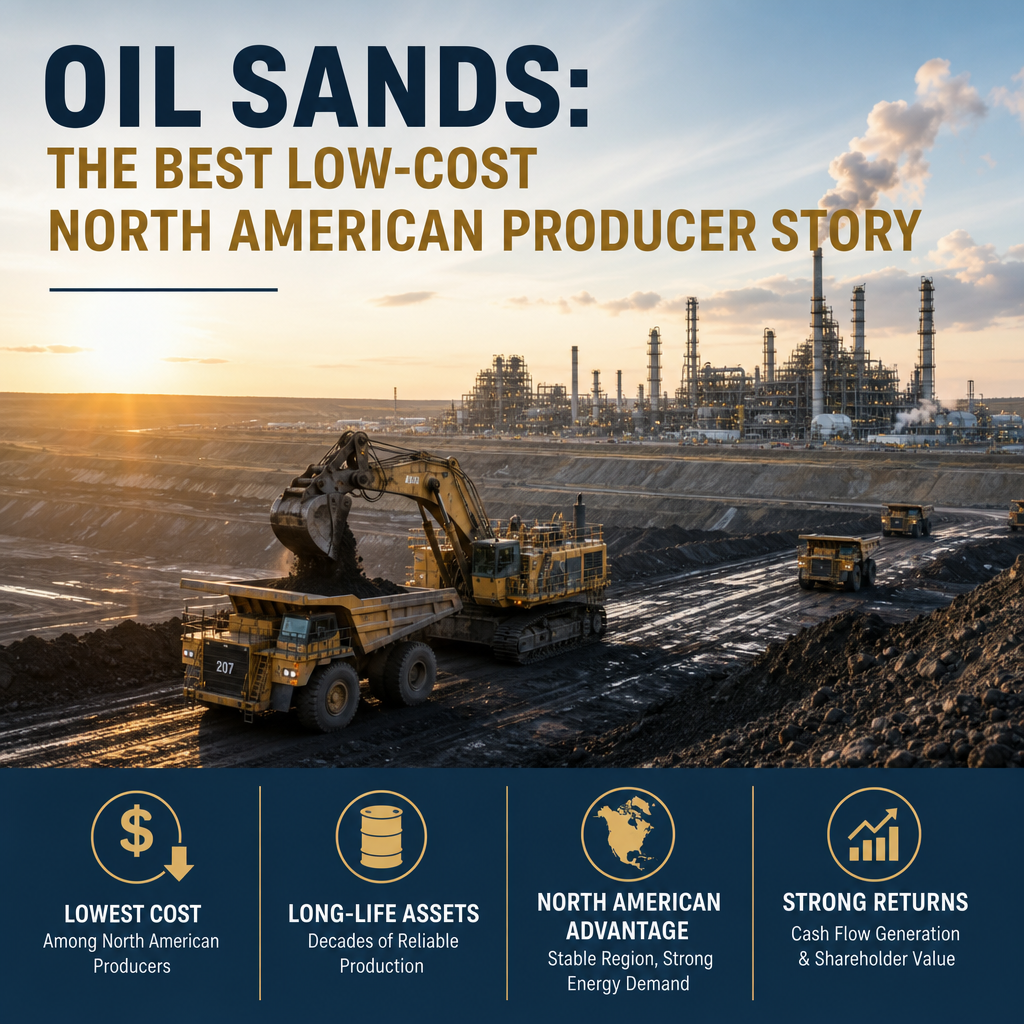
Oil sands are a mixture of sand, clay, water, and bitumen, a heavy form of crude oil that does not flow easily without treatment or heating. Unlike conventional oil reservoirs, which can often be produced by drilling and natural reservoir pressure, oil sands require either mining or in-situ extraction methods to recover the bitumen.
There are two main production approaches:
– Surface mining, used when deposits are relatively shallow
– In-situ recovery, commonly steam-assisted methods used for deeper deposits
Because the resource is so large, projects can produce for many years once the initial capital is spent. That longevity is a key reason oil sands are often described as a low-cost producer story over the long term, even if upfront development costs are high.
Why Oil Sands Are Considered a Low-Cost North American Producer Story
At first glance, oil sands do not always look low-cost. Building mines, upgrading plants, and steam facilities can require major capital investment. However, the real strength of the sector comes from how operating costs and reserve longevity work together.
Several factors support the low-cost narrative:
1. Long reserve life
Oil sands reserves are enormous, and that matters. Once infrastructure is built, companies can produce for decades from the same asset base. That reduces the need for constant exploration spending and can improve efficiency over time.
2. Large-scale operations
Many oil sands projects are designed to operate at industrial scale. Bigger facilities often lower per-barrel costs because equipment, labor, logistics, and processing are spread across higher volumes.
3. Technology improvements
Over the past two decades, operators have improved extraction efficiency, reduced steam-to-oil ratios, and optimized mining and upgrading processes. These gains have helped reduce operating costs and increase output reliability.
4. Existing infrastructure
North America already has a significant network of pipelines, refineries, rail systems, and service providers supporting the oil sands industry. This infrastructure helps move product and lowers some of the frictions that can affect frontier resource plays.
5. Stable jurisdiction
Compared with many global oil-producing regions, Canada offers a stable legal and political environment. That stability can reduce long-term risk premiums and make the overall production story more attractive to investors and partners.
The Cost Structure Behind Oil Sands Economics
To understand why oil sands remain competitive, it helps to look at the full cost structure rather than focusing on capital spending alone.
Capital intensity
Oil sands projects are expensive to build. Mining operations require major earth-moving equipment, processing plants, tailings systems, and ongoing reclamation planning. In-situ projects need steam generators, wells, water treatment, and facilities to handle produced fluids.
Operating discipline
Once facilities are running, operators focus heavily on keeping costs under control. Fuel use, labor productivity, maintenance, and downtime all affect profitability. Companies that can maintain high utilization often gain a strong advantage.
Break-even resilience
Many oil sands producers have improved their cost structures enough to remain profitable at moderate oil prices, particularly when projects are already constructed and debt levels are manageable. That makes them less vulnerable than some higher-cost global sources, especially when markets tighten.
Why North America Benefits From Oil Sands
Oil sands are not just a Canadian resource story; they are part of the broader North American energy system. Their importance extends into supply security, refining, and economic activity.
Energy security
A large, stable source of crude oil within North America reduces dependence on more volatile international supply chains. That matters during geopolitical disruptions or supply shocks.
Refinery demand
Many North American refineries are configured to process heavier crude oils, including oil sands blend stocks. This creates a natural market for production and supports continued demand.
Jobs and investment
Oil sands development supports a wide range of industries, from engineering and construction to transportation and maintenance. These projects can generate long-term employment and large tax contributions for provinces and the federal government.
Export strength
North American producers benefit when oil sands output reaches global markets through pipelines, rail, and export terminals. Even though transportation constraints can create pricing challenges, access to world markets helps producers monetize their reserves.
Challenges Facing the Oil Sands Industry
A balanced view requires acknowledging the obstacles. Oil sands are not a simple story of low costs and easy growth. Several challenges shape the industry’s future.
Environmental pressure
Oil sands development has faced sustained scrutiny because of greenhouse gas emissions, water use, and land impacts. Companies have responded with emissions-reduction projects, reclamation work, and efficiency improvements, but pressure remains high from regulators, investors, and advocacy groups.
Transportation bottlenecks
Market access is critical. When pipeline capacity is tight, producers may be forced to rely on rail or accept wider discounts on their crude. This can affect profitability even when production costs are stable.
Price volatility
Oil sands remain tied to global crude markets. Even efficient producers can struggle during prolonged downturns. Because the assets are capital intensive, companies need disciplined balance sheets to weather cycles.
Public perception and policy
Long-term growth depends partly on how governments balance economic benefits with climate policy. Carbon pricing, emissions standards, and permitting rules can affect project economics and investor confidence.
The Technology Angle: How Efficiency Is Improving
One reason the oil sands story remains relevant is that the industry has continued to innovate. Efficiency gains have been central to improving competitiveness.
Some of the most important trends include:
– Better reservoir modeling and drilling precision
– Steam optimization in in-situ projects
– Improved froth treatment and upgrading processes
– Automation and digital monitoring at mines and facilities
– Reduced water usage and improved tailings management
These advances do not eliminate environmental concerns, but they do help explain why the sector has remained viable despite pressure from many directions. In an industry where small cost reductions can have a major impact on margins, incremental improvements matter a great deal.
Oil Sands and the Future of North American Oil Supply
The future of oil sands depends on a mix of market demand, policy direction, and operational performance. Global oil demand is not disappearing overnight, and many analysts expect petroleum to remain a critical part of the energy mix for years to come. In that environment, oil sands may continue to serve as a reliable source of supply.
What will determine their role?
Capital discipline
The best-performing producers are likely to be those that resist overexpansion and focus on strong cash flow, debt reduction, and shareholder returns.
Emissions management
Companies that can lower emissions intensity and improve sustainability reporting may be better positioned to attract capital and maintain social license.
Market access
New pipelines, optimized export routes, and stronger integration with North American refining systems could improve pricing and reduce volatility.
Operational excellence
In a mature industry, the winners are often the operators who can produce consistently, control costs, and extend asset life efficiently.
Why the Oil Sands Story Still Matters
The oil sands remain one of the strongest examples of how a difficult resource can become a strategic, long-term energy asset through scale, technology, and persistence. They are not the cheapest barrels in every circumstance, but they offer something equally valuable: large reserves, dependable production, and the ability to compete in a continent-wide market.
For readers looking to understand the broader context, the OilPrice analysis of how oil sands became a low-cost North American producer provides useful background on the sector’s cost dynamics.
That is why the oil sands are often viewed as the best low-cost North American producer story. The phrase does not mean the resource is cheap to develop in the beginning. Instead, it reflects a broader truth: once built, operated efficiently, and connected to market infrastructure, oil sands assets can deliver durable production from one of the world’s most stable regions.
In an energy landscape shaped by uncertainty, that kind of reliability has real economic value.